Texas Seller’s Disclosure Notice Explained
What Texas law requires a seller to disclose, the eleven exempt transfers, and the buyer's right to terminate within seven days of receiving a late notice.
Texas law requires most sellers of a single-dwelling home to give the buyer a written seller’s disclosure notice — a signed statement of what the seller actually knows about the property. Section 5.008 of the Texas Property Code prescribes the form, lists eleven kinds of transfer it does not apply to, and gives a buyer who receives the notice late the right to terminate the contract for any reason within seven days.
What it is not is an inspection. The notice says so itself, in capital letters at the top: it is a disclosure of the seller’s knowledge of the condition of the property as of the date the seller signs it, and it is not a substitute for any inspections or warranties the purchaser may wish to obtain. It is also not a warranty of any kind by the seller or the seller’s agents.
Read that way, the notice is genuinely useful to both sides. For a buyer it is a map of where to point an inspector. For a seller it is cheap protection, because a problem the buyer knew about before signing is far harder to turn into a claim afterward.
What the notice asks a seller to answer
Section 5.008(a) lets a seller use either the form printed in the statute or a written notice substantially similar to it that contains, at a minimum, all of the same items. The versions in everyday use in Texas are all built on that statutory text, so the questions are the same wherever you see it.
The form works through the property in blocks:
- What is there. A checklist of equipment and systems — range, dishwasher, washer and dryer hookups, security system, fire detection equipment, ceiling fans, central heat and air, plumbing, septic system or public sewer, pool and pool equipment, fireplaces, natural gas or propane lines, garage and opener, water heater fuel type, and water supply (city, well, MUD or co-op). Roof type and approximate age go on the same page.
- Whether any of it works. One direct question asking whether the seller is aware of any listed item that is not in working condition, has known defects, or needs repair.
- Smoke detectors. Whether the home has working smoke detectors installed in accordance with Chapter 766 of the Health and Safety Code. The footnote also explains when a buyer may require the seller to install detectors for the hearing impaired: the buyer or a family member who will reside in the dwelling is hearing impaired, the buyer gives the seller written evidence of the impairment from a licensed physician, and within 10 days after the effective date the buyer makes a written request that specifies where the detectors go.
- Structural defects the seller knows about. Interior and exterior walls, ceilings, floors, doors, windows, roof, foundation or slab, basement, walls and fences, driveways, sidewalks, plumbing and sewers and septics, electrical systems and lighting fixtures.
- Conditions. Active termites and other wood-destroying insects, termite damage or previous treatment, previous structural or roof repair, improper drainage, water damage not due to a flood event, hazardous or toxic waste, asbestos components, urea formaldehyde insulation, radon gas, lead-based paint, aluminum wiring, previous fires, unplatted easements, landfill or settling or soil movement or fault lines, subsurface structures or pits, and previous use of the premises for the manufacture of methamphetamine.
- The paperwork around the house. Room additions, structural modifications or other alterations and repairs made without necessary permits or out of compliance with the building codes in effect at the time; homeowners association or maintenance fees and assessments; common areas co-owned in undivided interest with others; notices of violations of deed restrictions or governmental ordinances affecting the condition or use of the property; and lawsuits directly or indirectly affecting the property.
- Three more in the same block that are easy to skim past. Any condition on the property that materially affects the physical health or safety of an individual; any rainwater harvesting system larger than 500 gallons that uses a public water supply as an auxiliary source; and any portion of the property located in a groundwater conservation district or a subsidence district.
- Proximity to a military installation. The form closes with a standing statement that the property may be near a military installation and may be affected by high noise or air installation compatible use zones or other operations, and points the reader to the most recent Air Installation Compatible Use Zone Study or Joint Land Use Study, published on the installation’s website and on the county and city websites. If you are buying around Killeen or Harker Heights, that is the item to read closely rather than skim.
That unpermitted-work question is an easy one to answer carelessly. An enclosed patio or a converted garage done without a permit is a disclosable fact whether or not anyone ever complained about it.
Read the flood questions twice
The flood section is the most detailed part of the notice and the part that has grown the most. It asks separately about present flood insurance coverage, previous flooding caused by a failure or breach of a reservoir or a controlled or emergency release of water from one, and previous water penetration into a structure due to a natural flood event.
Then it asks the seller to mark whether the property lies wholly or partly in each of five things: a 100-year floodplain, a 500-year floodplain, a floodway, a flood pool, or a reservoir. Two further questions ask whether the seller has ever filed a flood damage claim with any insurer including the National Flood Insurance Program, and whether the seller has ever received FEMA or Small Business Administration assistance for flood damage.
The statute defines those terms rather than leaving them to guesswork. A 100-year floodplain is an area identified on the FEMA flood insurance rate map as a special flood hazard area — Zone A, V, A99, AE, AO, AH, VE or AR — with a one percent annual chance of flooding. A 500-year floodplain is a moderate hazard area, shaded Zone X, with a two-tenths of one percent annual chance. A flood pool is the area next to a reservoir that lies above the reservoir’s normal maximum operating level and is subject to controlled inundation managed by the United States Army Corps of Engineers.
That last definition matters in this part of Texas more than it does in most of the state, because Belton Lake and Stillhouse Hollow Lake are both Corps of Engineers reservoirs. Land above the normal water line near a Corps lake can still be inside the pool the Corps is entitled to flood, and a “yes” in that box is a signal to ask which line the house sits above before you go further. If you are shopping near the water around Belton, treat it as a question for the title commitment and the survey, not just the disclosure.
What a seller does not have to disclose
Section 5.008(c) is explicit: a seller or the seller’s agent has no duty to disclose or release information about whether a death by natural causes, suicide, or accident unrelated to the condition of the property occurred there, or about whether a previous occupant had, may have had, has, or may have AIDS, HIV-related illness, or HIV infection.
Subsection (d) sets the standard for everything else. The notice is completed to the best of the seller’s belief and knowledge as of the date it is completed and signed. If the seller does not know something, the seller indicates that on the notice, and by doing so is in compliance with the section. “Unknown” is a permitted answer. A guess dressed up as a fact is not.
The eleven transfers section 5.008 does not cover
Subsection (e) lists the transfers that are exempt from the requirement:
- Pursuant to a court order or a foreclosure sale.
- By a trustee in bankruptcy.
- To a mortgagee by a mortgagor or successor in interest, or to a beneficiary of a deed of trust by a trustor or successor in interest.
- By a lender or deed-of-trust beneficiary that acquired the property at a power-of-sale or court-ordered foreclosure sale, or by deed in lieu of foreclosure.
- By a fiduciary administering a decedent’s estate, a guardianship, a conservatorship or a trust.
- From one co-owner to one or more other co-owners.
- To a spouse, or to a person in the lineal line of consanguinity of one of the transferors.
- Between spouses under a decree of divorce or legal separation, or a property settlement incidental to one.
- To or from any governmental entity.
- Of a new residence of not more than one dwelling unit that has not previously been occupied for residential purposes.
- Of real property where the value of any dwelling does not exceed five percent of the value of the property.
Numbers 1, 4 and 10 are the ones that come up constantly: buy a foreclosure, a lender-owned home or a brand-new house and no seller’s disclosure notice is owed to you at all. Number 5 is narrower than people assume — it covers a sale by an executor, administrator, guardian or trustee in the course of administering the estate or trust, not a sale by an heir who has already taken title in their own name. An heir selling their own property owes you the notice like anyone else.
Where no notice is owed, the whole burden moves onto your own inspection, the survey, the title commitment and — on new construction — whatever written warranty the builder chooses to provide. Texas has not licensed home builders since the Texas Residential Construction Commission was abolished in 2009, and there is no statutory new-home warranty, so a builder warranty is a contract term you read rather than a protection you are owed. Budget for a private inspection on a new build for exactly that reason.
Timing, and the seven-day escape hatch
Subsection (f) does two things. First, it sets the deadline: the seller delivers the notice to the buyer on or before the effective date of an executory contract binding the buyer to purchase the property. Second, it supplies the remedy if that does not happen — if a contract is entered into without the seller providing the notice, the buyer may terminate the contract for any reason within seven days after receiving it.
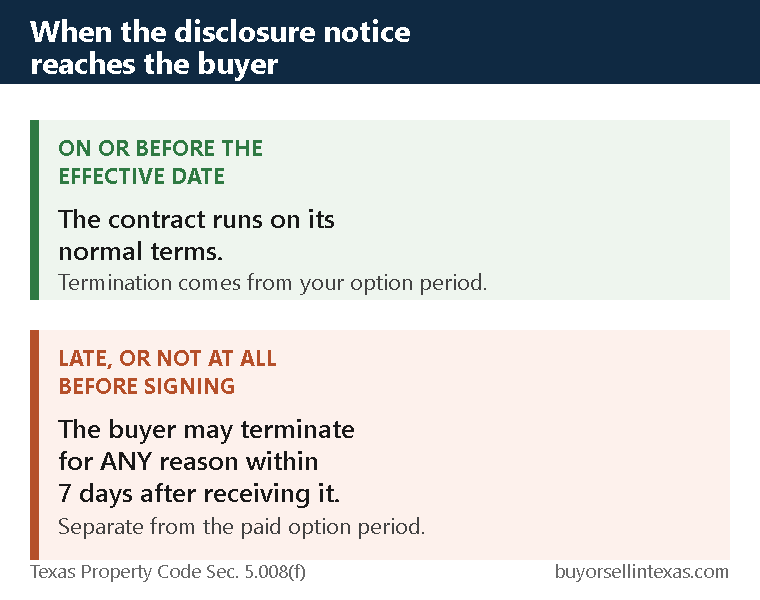
Two practical consequences follow. A buyer should ask for the notice before writing the offer, not after, because reading it first is what turns it into negotiating information rather than a post-signature surprise. And a seller should have it completed and signed before the home goes live, because handing it over late gives the buyer a free exit that has nothing to do with the inspection.
That seven-day right sits alongside, not instead of, the termination option you negotiate in the contract itself. My walkthrough of Texas property taxes, title and the option period covers how the paid option period works and how it interacts with earnest money.
Other notices that can ride along with it
Section 5.008 is the best known of the pre-contract notices but it is not the only one in Chapter 5.
- Public improvement district assessments (Section 5.014). A person proposing to sell property located in a public improvement district established under Subchapter A, Chapter 372 or under Chapter 382 of the Local Government Code must first give the buyer a written notice of the obligation to pay the district assessment. If a subdivision’s amenities were financed this way, the assessment travels with the lot.
- Water level fluctuations (Section 5.019). For property adjoining an impoundment of water — a reservoir or lake — constructed and maintained under Chapter 11 of the Water Code with a storage capacity of at least 5,000 acre-feet at normal operating level, the seller gives a written notice that the water level fluctuates, including because an entity is lawfully exercising its right to use the stored water, or because of drought or flood conditions. A waterfront view is not a guaranteed waterfront view. This notice carries its own enforcement: it is due on or before the effective date of the contract, a buyer who does not get it in time may terminate for any reason within seven days after receiving it — or after getting the same information from anyone else — and after closing a buyer may bring a misrepresentation action against a seller who failed to give the notice while actually knowing the water level fluctuates.
How to actually use the notice
As a buyer. Read the notice and the inspection report side by side. Where the inspector finds something the seller marked “no,” you are not necessarily looking at concealment — “no” means the seller is not aware — but you are looking at a question worth asking in writing. Pay particular attention to any “yes” in the flood block, any repair history described in a single vague line, and anything in the permits and HOA section. And treat every “unknown” on a house the seller has lived in for twenty years differently from an “unknown” from an heir who never set foot in it.
As a seller. Fill it out yourself, slowly, from what you know. Attach the extra sheets when the explanation does not fit. Disclose the repair you already made — a repaired problem disclosed is far better than a repaired problem discovered. If you do not know, write that you do not know, which the statute expressly accepts. The notice you complete carefully is the one that keeps a disagreement from becoming a claim after closing.
Getting it right before you list or write an offer
Many disclosure problems in Texas are not dishonesty. They come from a form completed in ten minutes on the day the sign went in the yard, or from a buyer who read it after signing instead of before.
If you are preparing to sell, walk through the seller’s side of the process and complete the notice early, while there is still time to fix or price what it reveals. If you are buying, the buying walkthrough sets out the order things happen in. Either way, get in touch and I will go through the notice with you line by line before anything is signed.
Written by Logan Parker, a Texas-licensed real estate agent with JD Walters Real Estate. Reviewed September 24, 2026. Sources: Texas Property Code sections 5.008, 5.014 and 5.019, read in full at the Texas Legislature’s statutes website; Texas Health and Safety Code Chapter 766, as referenced in the statutory notice. This is general information, not legal advice — a specific disclosure question belongs with a Texas real estate attorney.