Texas Property Taxes, Title and the Option Period
Texas homestead exemptions, the 10% appraisal cap, protest deadlines, title insurance pricing and the option period — what to know before you make an offer.
Texas has no state income tax. It pays for schools, counties, cities and special districts with local property taxes instead — which is why buyers moving here from almost anywhere else find the tax line on a Texas home larger than the one they left behind.
The part that catches people off guard is not the rate, though. It is the timing. Nothing about the previous owner’s tax situation follows the house to you automatically, your first year’s bill may have been calculated using someone else’s exemptions, and the protection that limits how fast your taxable value can climb does not switch on the day you close.
The same is true of two other things that surprise out-of-state buyers: title insurance here is priced by the state, and the window to inspect a house is a contract clock that starts before you have booked a flight. Here is how the pieces fit together, and what to pin down before you write an offer.
What Texas charges instead of an income tax
Property tax in Texas is not a single state tax. It is levied by local taxing units — your school district, the county, often a city, and sometimes a hospital district, a community college district, a road district or an emergency services district. Add up what each of those units charges against your taxable value and you have your bill.
That means two houses a few miles apart can sit inside different combinations of districts and owe noticeably different totals on the same value. A statewide average, or even a citywide one, will not tell you what a specific address costs. Ask for the list of taxing units attached to that parcel, then look up each one’s adopted rate with the county appraisal district.
It is worth seeing that worked through for a single county rather than in the abstract. This guide to what property taxes and exemptions look like in Bell County lays out the districts, the local exemption options and the appraisal district contacts for one Central Texas market — a useful model for the questions to ask wherever you land.
Your first-year tax bill may not really be your bill
Exemptions in Texas belong to the owner, not to the house. When a property changes hands, the new owner’s exemptions have to be applied for; they are not inherited from the seller.
Section 11.42(f) of the Texas Tax Code sets out the rule for mid-year buyers: someone who acquires a property after January 1 may receive the general residence homestead exemption for the applicable portion of that tax year as soon as they qualify — but only if the preceding owner did not receive the same exemption for that tax year.
In practice that splits buyers into two groups:
- The seller had no homestead exemption — a rental, a second home, an investor-owned property. You can generally pick up the general residence homestead exemption for your portion of the year you buy. The over-65 and disabled exemptions under Sections 11.13(c) and (d) are expressly excluded from this rule and begin the following January 1.
- The seller did have one — that exemption stays on the account for the rest of that tax year, and yours begins on January 1 of the following year.
This matters beyond the tax bill itself. If your lender built your escrow account around a tax figure that reflected the seller’s exemptions, and your own exemptions do not apply until the following January, the escrow can come up short and the payment gets adjusted. Ask your loan officer, in writing, what tax number went into the estimate and whether it assumed any exemption you do not yet have.
The homestead exemption, and the deadline attached to it
For a home you own and live in as your principal residence, the Texas Tax Code provides:
- A $140,000 residence homestead exemption that school districts must provide (Section 11.13(b)).
- An additional $60,000 from school districts for owners who are disabled or 65 or older (Section 11.13(c)).
- A local option exemption that any taxing unit may adopt, set as a percentage of appraised value that may not exceed 20%, with a floor of $5,000 where that percentage would produce less (Section 11.13(n)). Whether your county or city has adopted one, and at what percentage, varies by jurisdiction.
- A separate local option for owners who are disabled or 65 or older, of not less than $3,000 (Sections 11.13(d) and (e)).
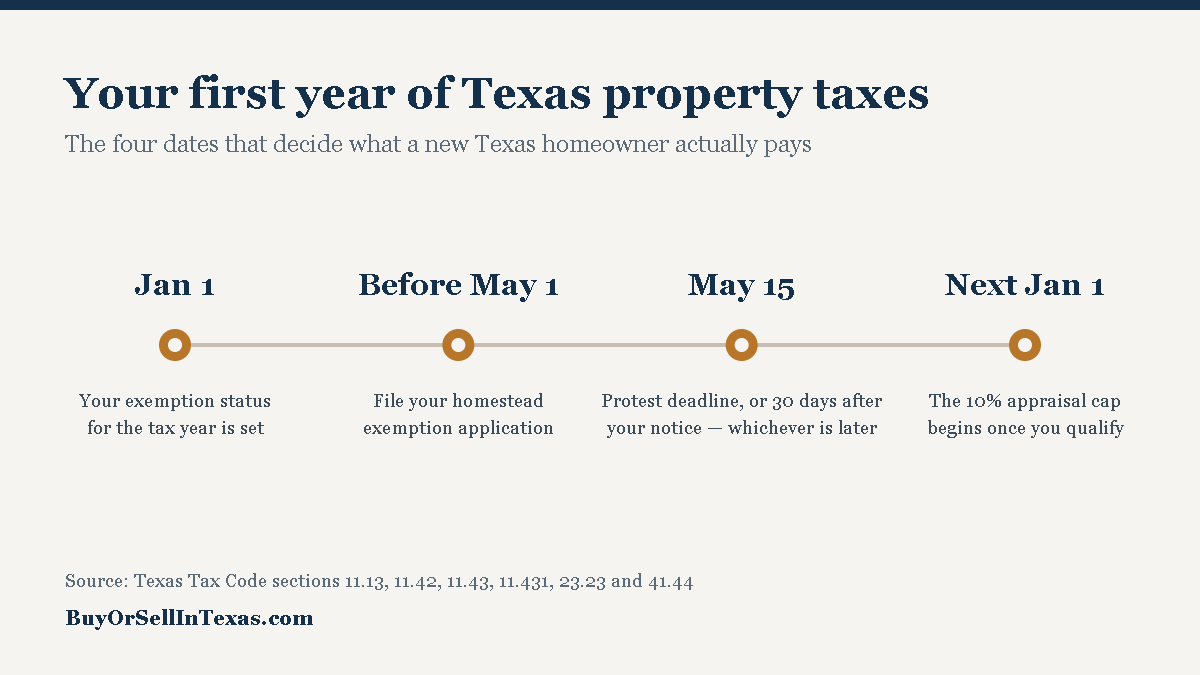
You apply on a state form filed with your county appraisal district, and the general deadline is before May 1. It is one page of work that new Texas homeowners routinely forget, or assume their title company has handled. Nobody files it for you.
If you do miss it, the year is not lost. Section 11.431 lets the chief appraiser accept a late residence homestead application filed not later than two years after the delinquency date for that year’s taxes — and if the tax was already paid, the collector refunds the tax imposed on the exempted amount without you having to apply separately for the refund.
Qualifying also starts the clock on the appraisal cap. Under Section 23.23, the appraised value of a residence homestead generally cannot be increased more than 10% a year — but that limitation takes effect on January 1 of the tax year following the first tax year the owner qualifies, and it lapses on January 1 of the first tax year in which neither that owner nor the owner’s spouse or surviving spouse qualifies for a Section 11.13 exemption. A home that has just changed hands is frequently reappraised upward, and the cap will not shield you from that first adjustment.
You cannot simply look up what the neighbors paid
Texas does not require sale prices to be disclosed publicly. As Texas REALTORS puts it, “Bills have been filed in every recent legislative session seeking to mandate sales price disclosure; however, lawmakers have not advanced this legislation.”
For a buyer arriving from a disclosure state, that changes the research. The automated “estimates” on national portals are working from incomplete sale data here, and a deed filed with the county clerk generally will not tell you what the property changed hands for. Closed-sale figures come through licensed agents with MLS access and through appraisals — which is also why a considered opinion of value matters more in Texas than a website number. If you are on the selling side, you can request one on my home valuation page.
Two closing costs that behave in opposite ways
Title insurance is priced by the state. The Texas Department of Insurance’s title FAQ is direct about it: “The premium rate is set by the Texas Department of Insurance,” and “All title companies will charge the same premium for a policy.” TDI also notes that when an owner’s policy and a loan policy are bought at the same time, the loan policy is issued at a discounted price of $100, and that buyer and seller may negotiate who pays the premium. Shopping title companies on premium is therefore pointless — choose on service, communication and how they handle closings.
Homeowners insurance is the opposite. Rates are not fixed by the state and vary considerably among carriers. TDI tells consumers to shop regularly and points them to its comparison site, HelpInsure.com, along with a public search of home and auto rate filings. Get several quotes for the specific address before your option period ends, not after — roof age, claims history on the property and distance to a fire station can all move the number.
The option period is your inspection window, and it is short
Most Texas resale transactions run on a promulgated form from the Texas Real Estate Commission, the One to Four Family Residential Contract (Resale), currently form 20-19. Paragraph 5 is the one to read twice:
- The buyer must deliver the earnest money and the option fee to the escrow agent within 3 days after the effective date.
- The termination option runs for a negotiated number of days after the effective date — not from the inspection, not from your flight landing.
- If no option fee amount is stated, or the fee is not delivered in time, the buyer does not have the unrestricted right to terminate.
- The option fee is credited to the sales price at closing.
If you are buying from out of state, line up an inspector before you are under contract rather than after. A week of the option period spent finding one is a week you do not get back.
Signing remotely is usually workable. Texas allows online notarization: an online notary public commissioned by the Secretary of State can notarize by two-way audio and video conference under Subchapter C, Chapter 406 of the Government Code. The notary has to be physically located in Texas at the time; the signer can be anywhere. Confirm early with your title company and your lender that both will accept it for your particular documents, because that is a common snag in remote closings.
If the value looks wrong, you can protest it
Appraisal notices go out in the spring. If yours looks out of step with the property, you can file a notice of protest with the appraisal review board — under Section 41.44(a), not later than May 15 or the 30th day after the notice was delivered to you, whichever is later.
A protest argues about how your property was appraised or exempted — value, unequal appraisal, a denied exemption. It is never about the tax rate. Rates are set by each taxing unit in its own budget process later in the year, and the appraisal review board has no say in them.
A short checklist for your first Texas year
- Get the exact list of taxing units for the address, not a city average.
- Ask whether the seller held a homestead exemption in the year you are buying.
- Ask your lender what tax figure the escrow estimate is built on.
- File your residence homestead application with the county appraisal district before May 1 of the year you qualify — and if you missed it, file late under Section 11.431.
- Quote homeowners insurance with several carriers during the option period.
- Watch for the appraisal notice each spring and calendar the protest deadline.
Talk it through before you write an offer
Most of this is easier to answer for a specific address than in general. If you are weighing a move to Central Texas, get in touch with the address or the area you are considering, and I will pull the taxing units, the exemption picture and a realistic view of what the first year looks like — before you are on the option-period clock. If you are earlier in the process, the buying walkthrough covers the steps in order.
Written by Logan Parker, a Texas-licensed real estate agent with JD Walters Real Estate. Reviewed September 18, 2026. Sources: Texas Tax Code sections 11.13, 11.42, 11.43, 11.431, 23.23 and 41.44; Texas Comptroller of Public Accounts; Texas Department of Insurance title insurance FAQ; Texas Real Estate Commission contract form 20-19; Texas Secretary of State online notary guidance; Texas REALTORS government affairs. This is general information, not tax, legal or insurance advice — confirm the specifics with your county appraisal district, your insurance agent, or another qualified professional.